
- Discovery Assays

Human

Mouse
Rat
Porcine
Canine
Equine
Sheep
Bovine

Chicken
- Custom Plex Assays

Human
Mouse
Rat
Porcine
Canine
Equine

Sheep

Bovine
Chicken
- My Account
-





















Ultrasensitive Immunoassays Breakthrough: Detecting Low-Abundance Biomarkers
For researchers in neuroscience, oncology, inflammation, and translational medicine, detecting biomarkers at vanishingly low concentrations can be a major challenge. These low-abundance biomarkers – often found at femtogram-per-milliliter levels – hold the key to early disease detection and nuanced understanding of disease biology. Traditional assays have struggled to detect such tiny signals, but new ultrasensitive immunoassays are changing the game.
In this post, we explore how state-of-the-art ultrasensitive platforms, such as Meso Scale Discovery® (MSD®), achieve femtogram-level detection and why this level of sensitivity is increasingly important for advanced biomarker discovery and translational research.
The Challenge of Low-Abundance Biomarker Detection
In many disease settings, key biomarkers circulate at concentrations so low that conventional assays approach or fall below their detection limits. In Alzheimer’s disease research, for example, blood-based biomarkers such as brain-derived phosphorylated tau 217 (BDpTau217), glial fibrillary acidic protein (GFAP), and neurofilament light (NF-L) are often present at femtogram-per-milliliter levels. These concentrations are substantially lower than what standard immunoassays can consistently measure.

A similar challenge exists in immunology and inflammation research, where cytokines such as interleukin-6 (IL-6) may be present at only a few picograms per milliliter in healthy individuals. Subtle changes at these low concentrations can reflect early or finely regulated immune responses, making accurate detection essential.
The ability to measure these low-abundance signals has important implications. Ultrasensitive assays can detect early biochemical changes associated with neurodegeneration, cancer recurrence, or immune activation well before they become apparent through clinical symptoms or imaging. In oncology, for instance, detecting tumor-associated proteins at ultralow levels may indicate minimal residual disease, providing early warning of potential relapse.
Early disease detection often depends on identifying this “needle in a haystack.” Advances in assay sensitivity have made it possible to detect protein biomarkers at levels 100–1000 times lower than traditional immunoassays, enabling researchers to study blood-based biomarkers that were previously measurable only in cerebrospinal fluid or tissue samples. This increased sensitivity expands the scope of non-invasive biomarker discovery and supports earlier, more precise insights into disease biology.
Ultrasensitive Immunoassays with Meso Scale Discovery® (MSD®)
Meso Scale Discovery® (MSD®) is at the forefront of this ultrasensitivity revolution. MSD’s assays employ an electrochemiluminescence detection system that marries specialized SULFO-TAG labels with patterned electrode plates. Upon electrical stimulation, the tags emit a bright, stable light signal, achieving femtogram-level sensitivity (down to ~0.05 pg/mL).
In practical terms, the MSD® platform enables quantification of biomolecules at concentrations that are often orders of magnitude lower than those detectable by conventional immunoassays. This level of sensitivity allows researchers to reliably measure biomarkers that may otherwise fall below the detection limits of standard ELISA or bead-based assays.
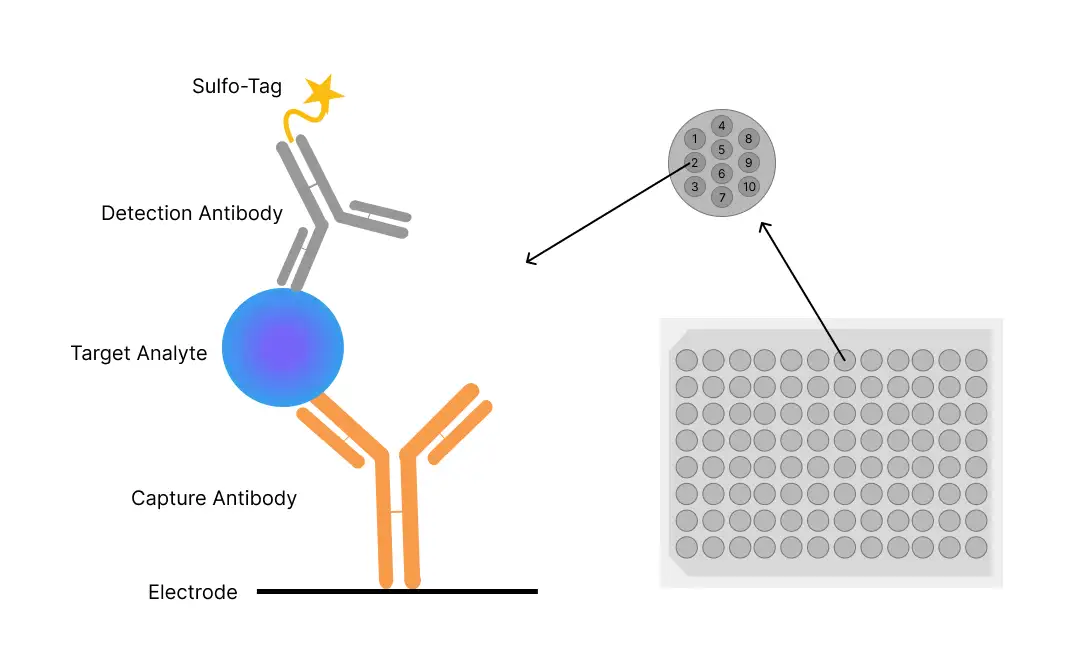
The advantages of MSD’s approach are manifold. First and foremost is its unparalleled sensitivity: true femtogram/mL detection limits. Researchers can reliably measure cytokines, neural proteins, and other analytes in the fg/mL range, where standard ELISAs or even bead-based assays might register nothing. This ultra-low limit of detection gives MSD® a clear edge when working with precious samples (such as cerebrospinal fluid or limited plasma) and detecting minute changes.
In addition to high sensitivity, MSD® assays provide a broad dynamic range, typically spanning three to four or more orders of magnitude. This allows low baseline concentrations and highly elevated disease-associated levels to be quantified within a single assay run, reducing the need for repeat dilutions and improving data completeness.
MSD®’s electrochemiluminescent detection also performs reliably in complex biological matrices such as serum, plasma, and tissue lysates. The platform is highly tolerant of matrix effects, maintaining strong signal-to-noise even in samples containing interfering proteins or lipids, and enabling confident detection of true low-abundance signals.
Finally, MSD® assays support multiplex measurement of up to 10 analytes per small-volume sample using MULTI-SPOT plates. While lower in plex size than some bead-based systems, this format balances targeted panel design with extreme analytical sensitivity, streamlined workflows, and rapid turnaround. Together, these features make MSD® well suited for studies requiring precise quantification of low-abundance biomarkers in real-world samples.
Ultrasensitive Assays in Action: Key Biomarker Examples
The impact of ultrasensitive MSD® immunoassays is best illustrated by biomarkers that circulate at extremely low concentrations, where femtogram-level detection enables measurements that are otherwise not possible.
Neurofilament Light (NF-L)
NF-L is released during neuronal damage and is present in blood at very low baseline levels. Small increases can reflect early neuroaxonal injury. Ultrasensitive assays enable reliable serum measurement of NF-L, supporting early detection and monitoring in neurodegenerative diseases and traumatic brain injury without the need for cerebrospinal fluid sampling.
Phosphorylated Tau 217 (pTau217)
A key Alzheimer’s disease biomarker, pTau217 in plasma was virtually undetectable until ultrasensitive immunoassays arrived. MSD’s S-PLEX® assays for pTau217 can measure just fractions of a picogram per milliliter, enabling differentiation of Alzheimer’s patients from healthy controls based on a simple blood test. Early and accurate measurement of pTau217 is transforming Alzheimer’s research – facilitating screening for clinical trials, tracking disease progression, and potentially even routine screening for at-risk individuals in the future.
Glial Fibrillary Acidic Protein (GFAP)
Reflects astroglial injury and neuroinflammation but circulates at very low levels under normal conditions. Ultrasensitive assays allow detection of subtle increases in plasma GFAP, supporting monitoring of mild brain injury and inflammatory neurological conditions using blood samples rather than cerebrospinal fluid. This means even a mild concussion’s biochemical impact can be measured, or ongoing neuroinflammation in diseases like multiple sclerosis can be monitored, all with a blood sample. What was once only measurable in cerebrospinal fluid via lumbar puncture can now be tracked in serum thanks to ultrasensitive technology.
Brain-Derived Phosphorylated Tau (BD-pTau217 & BD-pTau181)
CNS-specific tau biomarkers that are designed to better reflect Alzheimer’s disease pathology in blood by focusing on tau species originating from the brain rather than peripheral sources. This brain-derived specificity can improve signal-to-noise and reduce background compared with conventional plasma pTau measurements, supporting more accurate patient differentiation and longitudinal monitoring in Alzheimer’s research. Click to learn more.
Inflammatory Cytokines (e.g., IL-6, IL-1β, IL-10)
Cytokines orchestrate the immune response, but many circulate at trace levels in steady-state health. An ultrasensitive immunoassay can quantify these baseline levels and small upticks with confidence. For instance, IL-6 in a healthy person might be <5 pg/mL, but even a 1–2 pg/mL rise could indicate a developing infection or therapeutic response. MSD’s Ultra-High Sensitivity cytokine panels are designed for such scenarios – they can simultaneously measure a suite of cytokines (IL-2, IL-4, IL-6, IL-10, TNF-α, etc.) with femtogram-level precision. Importantly, this level of sensitivity also provides practical advantages when sample volume is limited or when samples have already been diluted. Even when expected concentrations fall in the picogram range, femtogram-level assay sensitivity allows reliable quantification from small input volumes or diluted samples without compromising data quality.
Together, these examples show how femtogram-level sensitivity expands the range of measurable biology, enabling earlier detection, improved monitoring, and deeper insight into subtle disease-related changes.
Why Researchers Choose Eve Technologies for MSD® Assays
There is no question that Meso Scale Discovery® (MSD®) is an exceptional platform when ultrasensitive detection is critical. When your biomarkers exist at femtogram-per-milliliter levels, choosing the right technology can determine whether your study succeeds or fails.
However, running MSD® assays in-house is expensive and resource-intensive, involving significant upfront investment.
Establishing an MSD® workflow requires purchasing and maintaining specialized instrumentation, training personnel, optimizing protocols, and committing to full assay plates — even when you only have a limited number of samples. For many labs, this quickly becomes cost-prohibitive. Outsourcing to third-party providers can also be challenging, as many labs require full-plate purchases or apply significant markups that strain research budgets.
This is exactly where Eve Technologies can help.
Pay-Per-Well MSD® Discovery Assays — No Full Plate Required
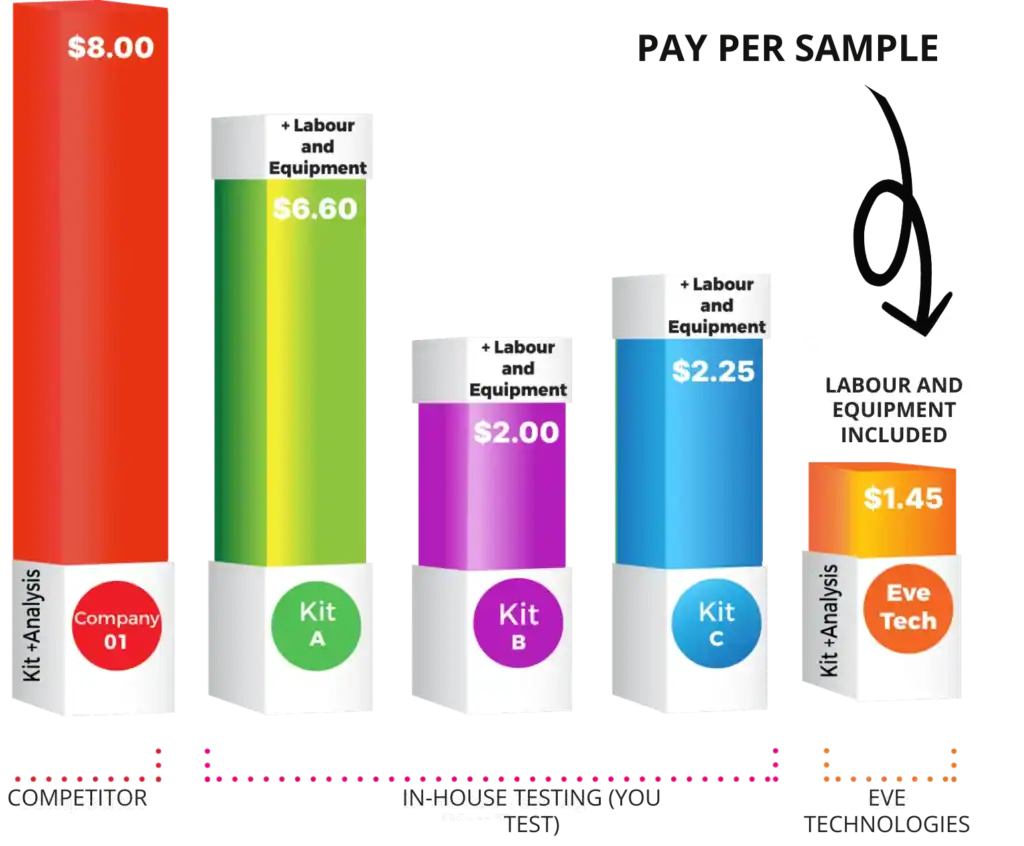
For many commonly requested biomarkers, Eve Technologies offers MSD® Discovery Assays with pay-per-well pricing. This means:
- Ideal for pilot studies, grant-funded projects, limited sample numbers, and budget-conscious research
- You only pay for the wells you actually use
- No requirement to purchase an entire plate
Researchers simply select the Discovery Assays they need, ship their samples, and receive high-quality, ultrasensitive data — without the overhead of running MSD® in-house.
Proven Expertise in High-Complexity Assay Execution
Executing MSD® assays at femtogram-level sensitivity requires more than instrumentation alone. At Eve Technologies, assays are performed by highly trained scientific staff with extensive experience in high-complexity immunoassays, including stringent control of analytical variables, quality assurance, and data validation.
This expertise ensures:
- Consistent assay performance across studies
- Data that are robust, reproducible, and publication-ready
Our clients benefit not only from access to advanced platforms, but from the technical proficiency required to use them correctly.
Custom MSD® Plex Assays — Built Specifically for Your Research
For projects that require custom analyte combinations or highly specific targets, Eve Technologies also offers Custom MSD® Plex assays. Because these assays are designed and optimized specifically for a single research project, they require a full-plate purchase.
This ensures:
- Proper assay development and validation
- Consistent performance across all samples
- Reliable, publication-quality data for complex or novel study designs
While Custom Plex assays involve a higher upfront commitment, they provide unmatched flexibility for researchers who need a tailored solution.
Affordable, High-Quality Data You Can Trust
Eve Technologies is widely recognized as one of the most affordable multiplex assay labs globally, without compromising data quality. Our services have supported thousands of peer-reviewed publications, including high-impact research published in Nature, PNAS, and other leading journals.
Many of our clients stay with us for years. And it’s all because of the consistency, reliability, and value we deliver. When researchers compare the cost, effort, and quality of doing it themselves versus working with Eve Technologies, the choice is clear.
Flexibility Across Platforms
While MSD® is ideal when ultrasensitive, femtogram-level detection is required, not every project needs that level of sensitivity. That’s why we also offer extensive multiplex assays on the Luminex platform.
If your priority is:
- Measuring more biomarkers simultaneously
- Running exploratory or discovery-stage studies
- Or finding an even more cost-effective option
Our Luminex-based Discovery Assays and Custom Plex solutions provide outstanding flexibility and value.
Focus on Your Science, and We’ll Handle the Rest
Imagine a workflow where all you need to do is choose your assays and send your samples. We handle assay execution, data generation, and quality assurance — and return what matters most: high-quality, actionable data for your research.
We are proud to support scientists at every stage of discovery and development, and grateful to play a role in enabling the next breakthrough.

If you’re unsure which platform or assay format is right for your study, or if you have questions about sensitivity, pricing, or feasibility, we’re always happy to help.