
- Discovery Assays

Human

Mouse
Rat
Porcine
Canine
Equine
Sheep
Bovine

Chicken
- Custom Plex Assays

Human
Mouse
Rat
Porcine
Canine
Equine

Sheep

Bovine
Chicken
- My Account
-





















Custom Multiplex Cytokine Panels: What Researchers Should Consider

Multiplex cytokine profiling has become a standard tool in immunology, oncology, neurology, and cardiovascular research. As studies become more targeted, many investigators consider custom multiplex cytokine panels to measure specific biomarkers relevant to their hypotheses.
However, designing or selecting a custom panel involves more than simply choosing analytes. Technical performance, cost efficiency, panel size, and study scope all influence whether a custom assay is the best option — or whether a predefined discovery panel may be more practical.
This guide outlines the technical and practical considerations researchers should evaluate when choosing a custom multiplex cytokine assay.
What Is a Custom Multiplex Cytokine Panel?
A custom multiplex cytokine panel allows researchers to select specific analytes to be measured simultaneously from a single sample using multiplex immunoassay platforms (for example, Luminex and MSD).
This approach is particularly well-suited to hypothesis-driven research and targeted biomarker validation and can be more cost-effective for larger studies by focusing only on the required analytes.
Unlike predefined panels, custom assays are designed to:
- Focus on specific immune pathways or mechanisms
- Investigate defined inflammatory or cytokine signatures
- Validate biomarkers identified in earlier studies
- Avoid measuring unnecessary or irrelevant analytes
This approach is particularly well suited to hypothesis-driven research and targeted biomarker validation, and can be more cost-effective for larger studies by focusing only on the required analytes.
For a broader perspective on the scientific advantages of measuring multiple biomarkers simultaneously, read our article: Multiplex Biomarker Profiling: Why Measuring Many Analytes Offers Deeper Biological Insight.
Choosing the Right Platform: Sensitivity vs Multiplex Capacity
Selecting the appropriate platform is a key decision in custom multiplex cytokine panel design, requiring a balance between sensitivity and multiplex capacity.
Cytokines often circulate at very low concentrations (picogram to femtogram per milliliter), making assay sensitivity a critical consideration. At the same time, study design may require measurement of a large number of analytes within a single sample.
When evaluating platform options, key parameters include:
- Lower limit of detection (LLOD)
- Upper limit of quantification (ULOQ)
- Dynamic range relative to expected biomarker levels
- Multiplex capacity (number of analytes per panel)
Multiplex platforms such as Luminex® and MSD® both offer broad dynamic ranges while conserving sample volume; however, they differ in their optimal use cases:
| Feature | Luminex 200® | Meso Scale Discovery ® |
| Multiplex capacity | High (30–80+) | Moderate (up to 10 per panel) |
| Sensitivity | pg/mL | fg/mL |
| Best for | Broad profiling | Low-abundance biomarkers |
| Use case | Discovery / screening | Targeted, ultrasensitive studies |
In practice:
- MSD is preferred when sensitivity is critical, particularly for low-abundance targets (for example, low-abundance brain injury biomarkers) (1).
- Luminex is advantageous when higher multiplexing is required for exploratory or profiling studies (2).
Platform selection should ultimately align with study goals, balancing the need for sensitivity with the desired panel breadth.
Eve Technologies offers custom multiplex panels on both platforms, with assay performance supported by the expertise and experience required to execute high-complexity multiplex immunoassays.
To better understand platform differences, including sensitivity, dynamic range, and multiplex capacity, read our detailed comparison: Multiplex Cytokine Assays Compared: Luminex®, Meso Scale Discovery®, and Traditional ELISA.
Sample Type and Matrix Effects
Matrix effects remain one of the most common challenges in cytokine quantification and can significantly impact assay accuracy, particularly in multiplex bead-based platforms.
Matrix effects arise from components within the sample (e.g., proteins, lipids, anticoagulants, or hemolysis) that can interfere with detection and contribute to increased variability in endogenous samples. These effects are more pronounced in fluidic, bead-based systems such as Luminex, whereas plate-based platforms like MSD®, which use electrochemiluminescence (ECL) detection, are generally less susceptible.
Researchers should consider:
- Serum vs. plasma compatibility
- Anticoagulant choice (e.g., EDTA vs. heparin)
- Effects of hemolysis
- Freeze–thaw stability
- Dilution requirements
Anticoagulant selection is an important contributor to these effects. EDTA helps limit metalloprotease activity, whereas heparin may introduce variability due to potential endotoxin contamination or interference with bead-based detection. As a result, heparin is often avoided in Luminex workflows.
Guidelines from organizations such as the Clinical and Laboratory Standards Institute (CLSI) emphasize the importance of standardized sample handling to ensure reproducibility (3).
Maintaining consistency in sample collection and handling is therefore critical, ensuring that observed differences reflect true biological variation rather than pre-analytical effects. We provide guidance on appropriate sample types and leverage our experience with multiplex immunoassays to apply established approaches that help mitigate matrix-related variability and support reliable data generation.
Custom Multiplex Cytokine Panels vs. Predefined Panels: What’s More Practical?
The choice between custom and predefined multiplex cytokine panels is primarily driven by study objectives, biomarker selection, and the level of assay flexibility required.
Custom multiplex panels are best suited for targeted, hypothesis-driven studies where specific biomarkers have already been identified. They enable focused evaluation of defined immune pathways, support validation of known targets, and allow panel composition to be aligned with the experimental design.
In contrast, predefined multiplex cytokine panels are commonly used in:
- Exploratory or discovery-stage research
- Broad immune profiling and cytokine screening
- Early-stage biomarker identification
Importantly, both custom and predefined panels are research-use-only (RUO) and are built on the same underlying assay platforms. The level of assay quality is not determined by the number of analytes, but by assay design and execution.
Larger panels also enable more advanced statistical analysis. High-dimensional datasets support multivariate approaches such as principal component analysis (PCA), hierarchical clustering, and network analysis, allowing researchers to identify coordinated cytokine responses and relationships between signaling pathways. For example, a COVID-19 study published in Nature (Lucas et al., 2020) (4) used multiplex assays from Eve Technologies to profile immune responses and revealed immune dysregulation over time.
The choice between custom and predefined panels is therefore driven by:
- Study stage (exploratory vs targeted)
- Level of prior biomarker knowledge
- Planned statistical analysis and data dimensionality
- Need for flexibility in panel design
- Desired balance between breadth and specificity
Selecting the appropriate approach ensures that assay design aligns with both the biological question and the downstream analytical strategy, supporting more robust and interpretable results.
Discovery Assays: Flexible Access to High-Plex Panels
For studies requiring broader biomarker coverage, predefined multiplex panels are often used to support exploratory or discovery-stage research.
At Eve Technologies, these are offered through our Discovery Assays model, which provides access to high-plex cytokine panels on a flexible, pay-per-well basis.
This approach allows researchers to generate high-dimensional datasets without committing to full plate capacity, making it particularly useful when:
This model is particularly advantageous when:
- Sample numbers are limited or variable
- Studies are exploratory or evolving
- A broader set of biomarkers is required
- Downstream statistical analysis benefits from higher data dimensionality
- Efficient use of budget is a priority
By decoupling panel size from plate commitment, Discovery Assays enable comprehensive cytokine profiling while maintaining flexibility in both study design and data generation.
Custom Panels vs. Discovery Assays: When to Choose Each
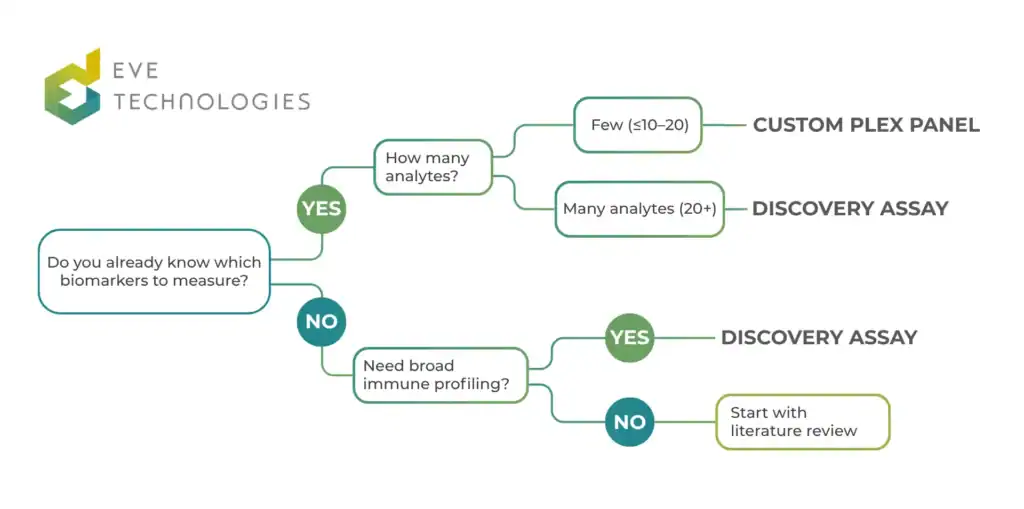
Both Custom Plex panels and Discovery Assays serve important but distinct roles in cytokine research.
Custom multiplex panels are best suited for:
- Targeted, hypothesis-driven studies
- Validation of specific biomarkers
- Mechanistic or pathway-focused research
- Situations where only a defined set of analytes is required
- Studies where focused data generation is preferred over breadth
Discovery Assays (predefined high-plex panels) are often the better choice for:
- Exploratory or discovery-stage research
- Broad immune profiling
- Studies aiming to identify new biomarkers or immune signatures
- Projects where maximizing insight per sample is a priority
- Study designs where downstream statistical analysis benefits from higher data dimensionality
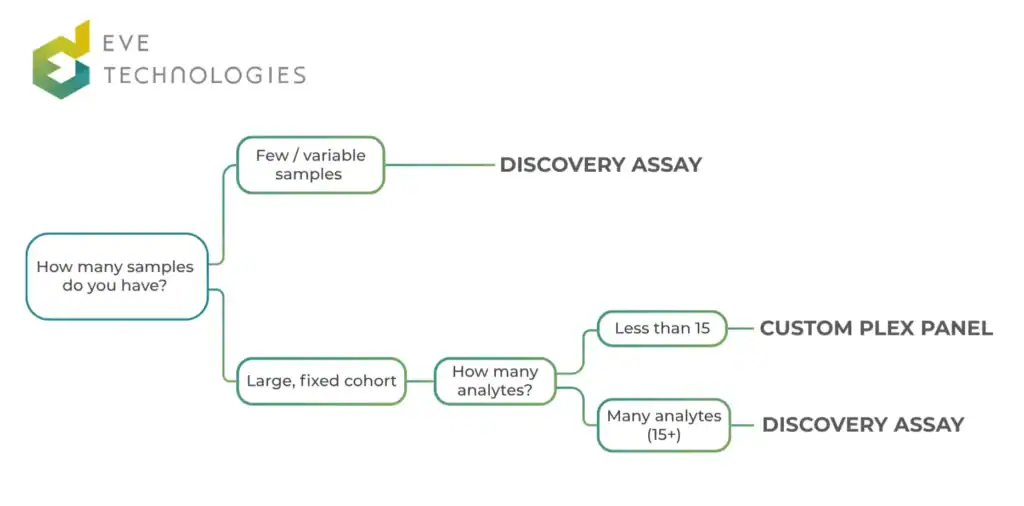
If you are unsure whether a Custom Plex panel or a Discovery Assay is the best fit, our team can help identify the most practical and cost-effective solution — with a focus on generating reliable, high-quality data for your study.
Why Work with an Experienced Multiplex Assay Laboratory
The performance of multiplex cytokine assays depends not only on panel design, but also on platform selection and execution. Even well-designed panels can underperform without the expertise required to run high-complexity assays consistently across diverse sample types.
At Eve Technologies, we focus on expert execution of established, off-the-shelf assays — ensuring they perform as expected and generate reliable, reproducible data.
We support researchers throughout the process, including:
- Pre-analytical guidance (sample type selection, handling, and shipping considerations)
- Assay selection guidance to ensure alignment with study goals and biomarker requirements
- Assay execution with consistent, high-quality performance
- Post-analytical support to help contextualize results
This level of scientific support is provided as part of our standard workflow.
Platform-Specific Insight: RANKL
For example, certain biomarkers demonstrate markedly different performance depending on the platform. Based on our experience running assays across both Luminex and MSD, RANKL is one analyte where platform selection is critical. Due to its low circulating levels, we consistently recommend MSD® assays, where higher analytical sensitivity enables more reliable and reproducible detection compared with bead-based systems.
Insights like this come from extensive hands-on experience across platforms and study types. In response to strong demand and consistent performance, we have also made RANKL available as a dedicated Discovery Assay on a pay-per-well basis, allowing researchers to access this optimized measurement without committing to a full panel.
For a deeper look at femtogram-level detection and its impact on biomarker research, see our article: Ultrasensitive Immunoassays Breakthrough: Detecting Low-Abundance Biomarkers.
Not all cytokines perform equally across platforms. Based on extensive cross-platform experience, RANKL is more reliably detected using MSD® due to its higher sensitivity.
This insight led to the development of a dedicated RANKL Discovery Assay at Eve Technologies, enabling optimized measurement without the need for a full custom panel.
Conclusion: Designing the Right Panel for Meaningful Results
Custom multiplex cytokine panels offer significant flexibility, but require careful study design to ensure reliable and interpretable outcomes.
Key factors include:
- Panel size and analyte compatibility
- Detection limits and dynamic range
- Sample type and matrix effects
- Study objectives and stage
- Planned downstream statistical analysis
Aligning panel design with these factors is critical to generating high-quality, reproducible data. Equally important is working with an experienced laboratory to ensure appropriate assay selection, robust execution, and guidance throughout the process.
Our work is reflected in thousands of peer-reviewed publications, including studies published in PNAS, Nature, and The BMJ. We support leading academic and clinical institutions worldwide.
With the right approach, multiplex cytokine assays can deliver data that not only meets technical expectations, but also supports meaningful biological insight.
You drive the science — we deliver the data.
Explore Multiplex Cytokine Panel Options
Eve Technologies offers both Custom Plex panels and Discovery Assays on Luminex and MSD® platforms, allowing researchers to select the most appropriate approach for their study.
For Custom Plex panels, researchers can choose from over 900 analytes, enabling highly tailored panel design aligned with specific biological pathways, targets, and study objectives. This flexibility supports both focused validation studies and complex, multi-marker investigations.
Whether your project requires:
- A focused set of validated biomarkers
- Ultrasensitive detection of low-abundance analytes
- Or broader multiplex profiling for discovery-stage research
Our team can help design and execute the right assay strategy based on your research goals, sample constraints, and budget.
References
- Mesoscale Discovery. (n.d.). S-PLEX® ultrasensitive immunoassay technology. https://www.mesoscale.com/en/products_and_services/services/s-plex
- DiaSorin. (n.d.). Luminex® 200™ System overview. https://int.diasorin.com/en/luminex/products-and-services/tools/luminex-200-system
- Clinical and Laboratory Standards Institute (CLSI). (2008). Collection, Transport, Preparation, and Storage of Specimens for Molecular Methods (MM13-A). https://clsi.org/shop/standards/pre04/
- Lucas, C., Wong, P., Klein, J., Castro, T. B. R., Silva, J., Sundaram, M., Ellingson, M. K., Mao, T., Oh, J. E., Israelow, B., Takahashi, T., Tokuyama, M., Lu, P., Venkataraman, A., Park, A., Mohanty, S., Wang, H., Wyllie, A. L., Vogels, C. B. F., … Iwasaki, A. (2020). Longitudinal analyses reveal immunological misfiring in severe COVID-19. Nature, 584, 463–469. https://doi.org/10.1038/s41586-020-2588-y
- Chowdhury, F., Williams, A., & Johnson, P. (2009). Validation and comparison of multiplex cytokine assays. Journal of Immunological Methods, 340(1), 55–64. https://pmc.ncbi.nlm.nih.gov/articles/PMC4332596/
- Leng, S. X., McElhaney, J. E., Walston, J. D., Xie, D., & Fedarko, N. S. (2008). ELISA and multiplex technologies for cytokine measurement in inflammation and aging research. Journal of Gerontology: Biological Sciences, 63(8), 879–884. https://doi.org/10.1093/gerona/63.8.879
- Khan, I. H., Krishnan, V. V., Ziman, M., Janatpour, K., Wun, T., Luciw, P. A., & Tuscano, J. (2009). A comparison of multiplex suspension array large-panel kits for profiling cytokines and chemokines in rheumatoid arthritis patients. Cytometry Part B: Clinical Cytometry, 76(3), 159–168. https://doi.org/10.1002/cyto.b.20452
- Bender, D. E., Schaettler, M. O., Sheehan, K. C. F., Johanns, T. M., & Dunn, G. P. (2021). Cytokine profiling in plasma from patients with brain tumors versus healthy individuals using two different multiplex immunoassay platforms. Biomarker Insights, 16, 11772719211006666.
https://doi.org/10.1177/11772719211006666 - Polley, N., Unger, B., Eve Technologies et al. (2023). Cytokine clustering reveals reproducible immune signatures across large human cohorts. Frontiers in Immunology, 14, 1223817. https://doi.org/10.3389/fimmu.2023.1223817